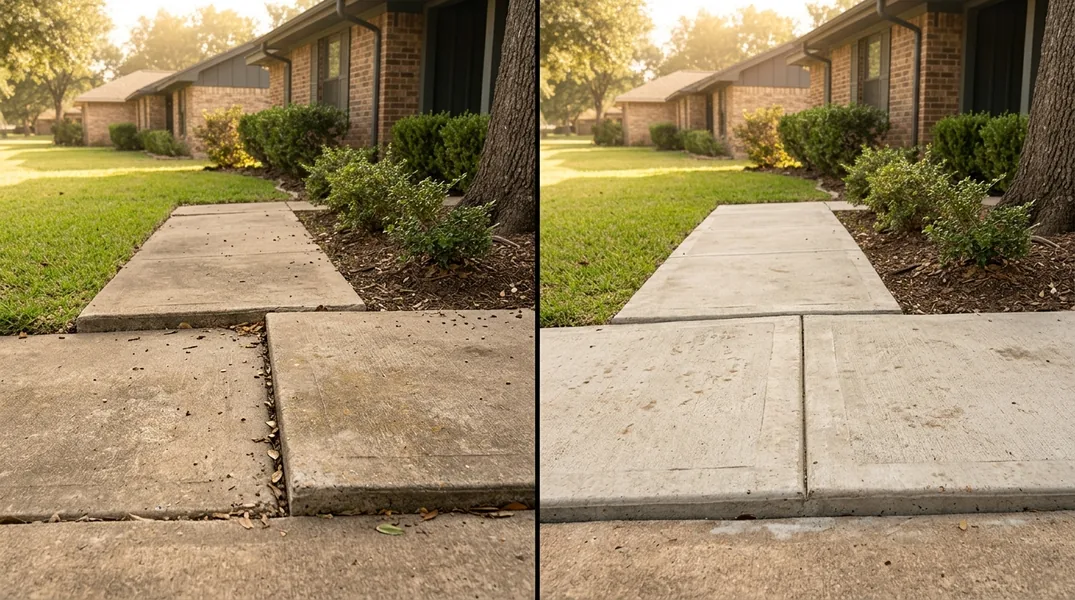
Understanding Brazos Valley Clay and Its Impact on Concrete
If you own a home in College Station, you've likely noticed the distinctive reddish-brown soil that defines the Brazos Valley landscape. This isn't ordinary dirt. The region sits atop expansive clay deposits that have shaped the area's geology for millennia, and today, that same clay poses a genuine challenge for homeowners with concrete driveways, patios, and foundations.
Expansive clay is a unique type of soil that swells when it absorbs moisture and shrinks when it dries out. In the humid Texas climate, this cycle happens repeatedly throughout the year. Spring rains soak the ground, causing the clay to expand. Summer heat and dry periods trigger shrinkage. Winter moisture and occasional freeze-thaw cycles add another layer of stress. This constant movement, known as shrink-swell action, exerts tremendous pressure on anything built on top of it, including your concrete surfaces. Unlike stable soils that remain relatively static, expansive clay is essentially a living, breathing foundation that never stops moving.
How Shrink-Swell Soil Damages Your Driveway
When expansive clay expands, it pushes upward with surprising force. A single cubic yard of clay can exert pressures exceeding 10,000 pounds per square inch as it swells. Your Concrete Driveways rest on this unstable foundation, and that upward pressure translates directly into structural stress. The concrete, which is rigid and brittle, cannot flex to accommodate the movement. Instead, it cracks.
The cracks that develop from expansive soil typically follow predictable patterns. You'll often see diagonal cracks running across the slab, or a series of parallel fractures that resemble a map. Sometimes, entire sections of the driveway heave upward, creating dangerous tripping hazards and unsightly humps. These aren't cosmetic problems. Once the cracking begins, water infiltrates the concrete, accelerating deterioration and making repairs more costly down the road. In College Station, where clay content in the soil is particularly high, this damage is not a matter of if but when.
College Station Soil Concrete: Why Your Neighbor's Driveway Is Cracking
You don't need to be a geologist to understand why concrete problems are so common in this area. The USDA soil surveys for Brazos County identify the dominant soil series as Hearne, Navasota, and Calvert clays, all of which exhibit high shrink-swell potential. These soils are classified as vertisols, a fancy term for soils dominated by montmorillonite clay minerals that are especially reactive to moisture changes. When you walk through a College Station neighborhood and see multiple driveways with visible cracks, that's not bad luck or poor installation. That's the local geology asserting itself.
The problem intensifies depending on where your property sits. Low-lying areas that collect water experience more dramatic expansion cycles. Properties with poor drainage, or those situated where gutters deposit roof runoff directly onto the soil, face accelerated damage. Even the orientation of your driveway matters. A slab that receives intense afternoon sun will dry faster on top than on the bottom, creating differential movement that causes cracking. These site-specific factors mean that two driveways built with identical concrete and methods can age completely differently based on their exposure to moisture and sun.
Expansive Clay Slab Cracking: Prevention and Early Detection
The best defense against expansive clay slab cracking is prevention, which starts before the concrete is ever poured. Professional contractors in College Station know that proper site preparation is critical. This includes removing unsuitable topsoil, compacting the subgrade correctly, and in many cases, installing a moisture barrier or improved base material to reduce direct contact between the concrete and expansive clay. Some contractors use rigid foam insulation or recycled asphalt to create a transitional layer that accommodates movement better than clay alone.
For homeowners with existing driveways, early detection of cracks can prevent expensive repairs. Small hairline cracks are normal in any concrete, but wider cracks (more than 1/4 inch), step cracking, or heaving sections signal problems with the underlying soil. Monitor your driveway seasonally. Spring is often when you'll notice the most dramatic changes because the soil is saturated from winter and spring rains. If you spot concerning cracks, don't wait. Contact College Station Concrete at (979) 271-5246 to schedule a free estimate. Early intervention with Concrete Repair & Resurfacing is far more cost-effective than replacing an entire slab.
Concrete Repair College Station: Solutions for Expansive Soil Damage
When expansive clay has already done its damage, you have several repair options depending on the severity of the cracking. Minor cracks can be sealed with concrete caulk or epoxy injections to prevent water infiltration. These solutions are temporary but can extend the life of your driveway by several years. For more significant damage, partial removal and replacement of the affected section may be necessary. This approach preserves the rest of your driveway while addressing the problem area directly.
For severely compromised slabs, complete removal and replacement is sometimes the most practical solution. This is also an opportunity to implement better moisture management and base preparation. Modern Concrete Repair & Resurfacing techniques can include installing proper drainage systems, using soil stabilization products, or applying protective coatings to the new concrete. College Station Concrete has extensive experience working with the region's challenging soil conditions and can recommend the best approach for your specific situation. Call (979) 271-5246 today or visit our website to learn more about how we handle expansive soil issues.
Long-Term Maintenance: Protecting Your Concrete in Expansive Soil
Once your driveway is repaired or replaced, ongoing maintenance becomes your best investment in longevity. Manage moisture around your driveway actively. Direct downspouts away from the concrete, maintain gutters to prevent overflow, and consider grading the landscape to promote drainage away from the slab. During dry seasons, occasional deep watering of the soil around your driveway can help maintain more consistent moisture levels and reduce the severity of shrinkage cracks. The goal is to minimize the dramatic swings between wet and dry that make expansive clay so destructive.
Seal your concrete regularly, typically every two to three years in the College Station climate. A quality concrete sealer reduces water penetration and helps protect the surface from the elements. Avoid allowing water to pool on your driveway, and address any new cracks promptly before they widen. If you're considering adding a new Concrete Patios or other concrete features to your property, discuss soil stabilization options with your contractor upfront. These preventive measures, combined with professional maintenance, can help your concrete withstand the unique challenges posed by Brazos Valley clay for decades to come.
Looking for a professional concrete contractor in College Station? College Station Concrete responds fast for all your concrete needs.
Get a Free QuoteOur services: Concrete Driveways · Concrete Patios · Stamped & Decorative Concrete