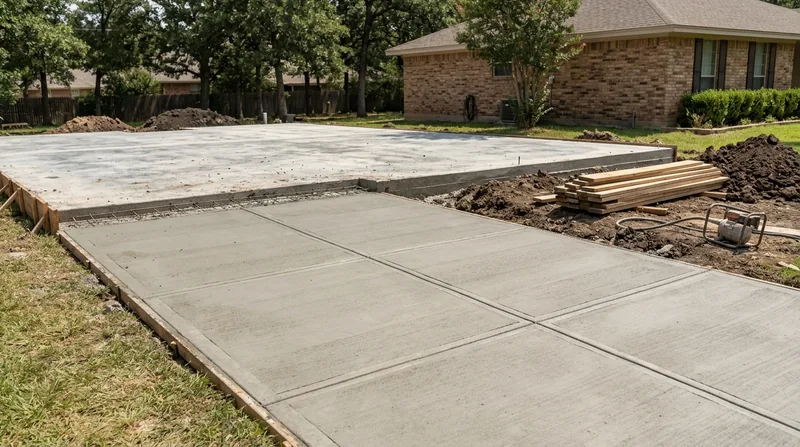




Concrete slabs and foundations in College Station face a unique challenge: the dark, highly expansive clay beneath our Post Oak Savannah landscape swells after spring thunderstorms and tropical rains, then shrinks and cracks during our long, hot summers. Whether you are building a garage foundation in the brick ranches of College Hills, adding a shed slab to a Southwood Valley home, or pouring the base for a room addition in Pebble Creek, the ground beneath your feet demands engineered thickness, proper steel reinforcement, and a compacted base that won't heave or settle. College Station Concrete builds slabs and foundations that stand firm against our climate and soil for decades, not years. We handle the entire process from site prep through finishing, and we understand the specific permit requirements and setback rules that the City of College Station enforces for residential concrete work.
Why Concrete Slabs and Foundations Matter in College Station's Shrink-Swell Clay
The Brazos Valley's clay-heavy soil is the real enemy of concrete. After a Gulf rain event or a week of spring storms, moisture swells the clay beneath a slab by several inches. When summer heat arrives and the ground dries, that clay shrinks back, leaving voids and cracks at joints and around the edges. A poorly prepared base or undersized reinforcement will fail in 5 to 10 years. A properly engineered slab with the right depth, steel mesh or rebar, control joints, and a solid compacted base will carry loads and resist the seasonal heave-and-settle cycle that dominates concrete failure in College Station.
- We compact the subgrade to 95 percent Proctor density and install a 4 to 6 inch gravel base to manage water infiltration and distribute load evenly.
- We specify slab thickness based on the intended use, soil bearing capacity, and local frost depth, typically 4 to 6 inches for residential work.
- We place steel reinforcement (wire mesh, rebar, or both) at mid-depth to resist tension and cracking from soil movement and temperature change.
- We cut control joints at intervals to direct cracking into straight, predictable lines rather than random patterns across the slab.
- We finish the surface to code and slope it for drainage so water does not pond on the concrete or seep beneath it.
These steps transform a concrete slab from a temporary patch into a lasting structural element that handles the College Station climate.
Local reality: Homeowners in Bryan, Navasota, and College Station who skip proper base prep or use thin concrete often see cracks and settlement within 2 to 3 years. We have replaced dozens of failed slabs that were poured over uncompacted fill or clay without reinforcement. Getting it right the first time saves thousands in repair and replacement costs later.
For more information on permit requirements for concrete work in College Station, visit the City of College Station Public Works Department.
How We Build Concrete Slabs and Foundations in College Station
Our process starts with an on-site assessment of soil conditions, drainage, and the intended use of the slab. We then mark out the area, set forms, and prepare the subgrade by removing topsoil, compacting the base, and installing gravel or recycled asphalt to manage moisture and provide a stable bearing layer. Once the base is set, we lay out reinforcement, pour the concrete to the specified thickness, and finish the surface with proper slope and texture. Every step is timed to the local weather and cured in the heat and humidity of the Brazos Valley.
- We meet with you on site to assess soil, drainage, and the scope of work, then provide a detailed estimate and timeline.
- We obtain any required permits from the City of College Station and notify utilities to mark underground lines before we break ground.
- We remove topsoil, compact the subgrade to 95 percent density, and install a 4 to 6 inch gravel base with proper drainage slope.
- We set forms to the correct height and grade, then lay out steel reinforcement (wire mesh, rebar, or both) at mid-depth.
- We order and pour concrete to the specified thickness and strength, then finish the surface with proper slope, broom finish, or other texture as requested.
- We cut control joints, allow the concrete to cure for 7 days, then remove forms and backfill the perimeter.
The entire process typically takes 1 to 3 weeks depending on slab size, soil conditions, and weather. For more details on how we approach foundation work for additions and new construction, see our Concrete Repair & Resurfacing page.
Example: A homeowner in Southwood Valley wanted to build a 12 by 16 foot shed slab on a lot with dense clay and poor drainage. We excavated 18 inches, installed a 6 inch gravel base with a perimeter drain, poured a 5 inch slab with wire mesh and control joints, and finished with a broom texture for traction. The slab has held firm for three years through multiple freeze-thaw cycles and heavy spring rains, with no cracking or settlement.
Concrete Slab and Foundation Methods: Choosing the Right Approach
| Approach | Description | Best for |
|---|---|---|
| Monolithic Slab | Concrete footing and slab poured as one unit in a single pour, with thickened edge or stem wall for structural support. | Residential garages, sheds, room additions, and light commercial work in stable soil with good drainage. |
| Stem Wall and Slab | A concrete footing is set below frost depth, a stem wall is built on the footing, and the slab is poured on top, creating separation between soil and living space. | Homes, crawl spaces, and structures where moisture control and frost protection are critical in clay soils. |
| Pier and Beam | Concrete piers are drilled or driven into stable soil or bedrock, and the structure is supported on concrete beams spanning between piers, with no slab in contact with soil. | Homes on highly expansive clay, sloped terrain, or where future access to utilities is needed; common in older Bryan and College Station neighborhoods. |
| Post-Tensioned Slab | High-strength cables are tensioned within the concrete to counteract shrinkage and heave from clay movement, allowing thinner slabs on problem soil. | Large commercial slabs, homes on severely expansive clay, or where minimal cracking is required; engineered design is essential. |
| Thickened Edge Slab | A standard slab with a thickened perimeter or edge beam that extends deeper into the soil to resist edge heave and provide extra load capacity. | Residential slabs in clay where minor heave is expected; balances cost and performance in College Station and surrounding areas. |
Each method has a different cost, installation time, and long-term performance profile. We assess your soil, site conditions, and intended use to recommend the approach that delivers the best value and durability for your College Station property.
Concrete Slabs and Foundations Cost in College Station: What to Expect
Concrete slab and foundation pricing in College Station starts at around $5 to $8 per square foot for a straightforward residential slab with standard base prep, wire mesh reinforcement, and basic finishing. A 12 by 16 foot shed slab (192 square feet) typically runs $960 to $1,536 before site-specific factors. A larger garage foundation or room addition slab can range from $2,000 to $6,000 or more depending on size, soil conditions, and finish type. Complex projects with poor drainage, deep excavation, engineered reinforcement, or specialty finishes cost more.
Several factors move the price up or down. Soil conditions matter most: dense clay or fill that requires extra excavation and compaction, or poor drainage that demands a thicker gravel base and perimeter drain, will add $1 to $3 per square foot. The depth and type of reinforcement (wire mesh versus rebar) affects cost. Finish type (broom, smooth trowel, or textured) has a smaller impact. Site access, proximity to structures, and the need for a separate footing or stem wall also influence the final number. Permit requirements in College Station may add $200 to $500 depending on the scope and whether utilities or right-of-way are involved.
We always recommend getting 2 to 3 estimates from insured concrete contractors in College Station before you commit. A low bid often reflects shortcuts in base prep or reinforcement, not genuine efficiency. Our estimate process is free, includes a soil and site assessment, and comes with a detailed breakdown of labor, materials, and timeline. For a full pricing overview and current rates, visit our pricing page or call us at (979) 271-5246 to schedule a free on-site estimate.
Concrete Slabs and Foundations Near Me: What to Look for When Hiring a Contractor in College Station
Hiring the right concrete contractor is as important as the design itself. A professional will assess your soil, explain the base prep and reinforcement required for your site, and deliver a slab that resists the heave and settlement that plagues poor installations. When you are evaluating contractors near College Station, focus on insurance coverage, references, permit knowledge, and a clear, detailed estimate that explains what is included and why.
Start by verifying that the contractor carries general liability insurance and workers compensation insurance for the job. Ask for a certificate of insurance naming you as an additional insured. Do not hire a contractor who works uninsured; if someone is injured on your property, you could be liable. Request references from recent jobs in College Station or Bryan, and call at least two of them to ask about the quality of base prep, how the slab has held up over time, and whether the contractor showed up on schedule and communicated clearly.
Ask about permit requirements for your specific project. The City of College Station requires permits for most residential concrete work, especially if it affects drainage, setbacks, or right-of-way. A reputable contractor will handle the permit process and explain any HOA restrictions or easements that affect your slab. Get a written estimate that breaks down labor, materials, base prep depth, reinforcement type, and finishing. If the estimate is vague or unusually low, ask why, and be skeptical of answers that skip base prep or reinforcement.
Finally, check that the contractor is responsive and willing to answer questions about soil conditions, drainage, and long-term care. A good contractor will explain why certain steps matter and will stand behind the work with a warranty or guarantee. If you are ready to move forward, contact us at College Station Concrete to request a free estimate, or call (979) 271-5246 to discuss your project and schedule a site visit.
Concrete Slabs & Foundations in College Station: Pricing Guide
| Service | Price | Details |
|---|---|---|
| Residential Slab (Monolithic or Thickened Edge) | Starting at $5-$8/sq ft | Standard 4 to 5 inch slab with wire mesh, gravel base, control joints, and broom finish; price increases with site excavation and soil compaction needs |
| Garage Foundation or Room Addition | Starting at $6-$9/sq ft | Engineered slab with stem wall option, deeper base prep, and reinforcement; pricing reflects larger footprint and structural requirements in College Station clay |
| Stem Wall and Slab (Crawl Space or Moisture Control) | Starting at $8-$12/sq ft | Footing set below frost depth, stem wall built on footing, slab poured on top; higher cost reflects additional concrete, excavation, and frost protection labor |
| Complex or Site-Specific Project (Poor Drainage, Fill Soil, Steep Slope) | On estimate | Requires on-site soil assessment, engineered design, and possible perimeter drain or specialized reinforcement; cost determined after site visit and soil testing |
| Travel and Site Visit | Included | No mileage fee or call-out charge within College Station and surrounding service areas; travel cost is built into the estimate |
| Free Estimate | Free | No obligation, detailed scope and pricing provided within 24 hours; call (979) 271-5246 to schedule your on-site assessment |
Indicative pricing, the exact cost depends on square footage, finish, and site access. Free personalized estimate within 24h at (979) 271-5246.


