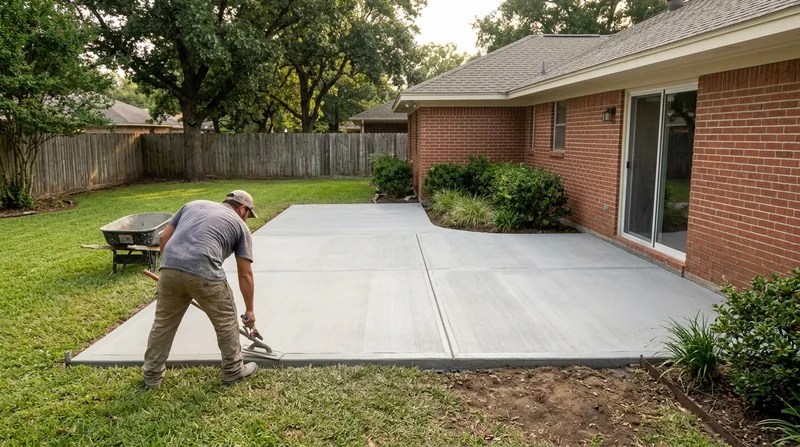




Concrete patios in College Station transform your backyard into a durable outdoor living space that withstands the Brazos Valley's intense summer heat, Gulf-driven spring storms, and the region's notorious clay-driven ground movement. Whether you own a 1960s cottage in College Hills with a single-car drive under post oaks, a 1980s brick ranch in Southwood Valley with an aging patio, or a newer two-story home in Pebble Creek or Castlegate with space for an expanded entertaining area, a properly poured concrete patio adds real value and extends your living season. The challenge in College Station is not just heat and humidity, but the dark, highly expansive shrink-swell clay beneath the sandy topsoil that heaves and settles with seasonal moisture swings, cracking poorly built slabs at joints and creating uneven surfaces. We build patios with solid base preparation, proper control joints, and correct slope for drainage so your outdoor space stays level, safe, and beautiful for decades. Call (979) 271-5246 for a free estimate, or explore our full range of concrete services to see how we can improve your home.
Why Concrete Patios Matter in College Station's Challenging Climate
College Station sits on Post Oak Savannah terrain where the soil is the real enemy. After Gulf rains in spring and early summer, the clay swells; during the long, dry heat of July through September, it shrinks and cracks. A patio poured without proper base preparation, reinforcement, and control joints will fail within a few years, heaving at the edges, settling in the middle, and cracking at the seams. Homeowners in subdivisions like Shenandoah, Emerald Forest, and around Northgate often inherit aging patios that have done exactly that. A new concrete patio built to College Station standards means a solid compacted base, proper steel reinforcement, adequate thickness (typically 4 inches for residential use), and control joints spaced to manage the inevitable movement.
- We compact the subgrade and install a gravel or recycled asphalt base to promote drainage and reduce hydrostatic pressure under the slab.
- We set control joints every 4 to 6 feet to direct cracking into planned lines rather than random fractures across the slab.
- We slope the finished surface at 1/8 inch per foot away from your home so water runs off instead of pooling and accelerating freeze-thaw damage.
- We finish with a broom or decorative texture that provides slip resistance and hides minor surface wear over time.
These steps ensure your patio survives the Brazos Valley's extreme seasonal swings and heavy rain events without premature cracking or settlement.
College Station reality: The clay-loam soils around Bryan and College Station are among the most expansive in Texas. A patio poured on inadequate base prep will heave 1 to 2 inches in a single wet spring, creating trip hazards and visible cracks. Proper preparation costs a little more upfront but eliminates costly repairs in 3 to 5 years.
For more on how ground conditions affect concrete work, visit the concrete repair and resurfacing page to see what happens when patios fail.
How We Build Concrete Patios in College Station: Our Process
Every patio starts with a detailed site visit. We assess drainage, soil conditions, proximity to trees (post oaks and pecans drop roots that can heave slabs), existing structures, and your intended use. We then walk through the steps: excavation to proper depth, base preparation, forming, reinforcement placement, pouring and finishing, and curing. We pull local permits if required and coordinate with your HOA if you live in Castlegate, Shenandoah, or another restricted community. Our goal is a finished patio that looks clean and professional and functions reliably for 20+ years even as the Brazos Valley climate cycles through wet springs and hot, dry summers.
- We mark out the patio footprint and check for underground utilities, grade changes, and tree root zones.
- We excavate to the correct depth, typically 4 to 6 inches depending on soil type and intended use, removing any soft or organic material.
- We compact the subgrade with mechanical equipment and install a 4-inch base of compacted gravel or recycled asphalt to improve drainage.
- We set forms (typically 2x4 or 2x6 lumber) to the finished height and slope, securing them so they won't shift during the pour.
- We place rebar or wire mesh for reinforcement, positioned in the middle third of the slab thickness.
- We order and pour ready-mix concrete to the forms, working it with vibrators and screeds to remove air pockets and ensure even consolidation.
- We finish the surface with broom, trowel, or decorative techniques, then cover and mist-cure the slab for at least 7 days so it hardens properly.
This methodical approach prevents the settling, heaving, and cracking that plague rushed or poorly prepared patios in College Station.
Local example: A homeowner in Southwood Valley had an old 1980s patio that had settled 2 inches on one side and cracked badly. We removed the old concrete, re-graded and compacted the base, and poured a new 16 by 20 foot patio with proper slope and control joints. The result: a level, safe, attractive outdoor space that will serve the home for decades.
If you are considering stamped or colored finishes to match your landscaping or complement your home's stone or brick, visit our stamped and decorative concrete service page for design options.
Concrete Patio Methods: Finishes and Techniques
| Approach | Description | Best for |
|---|---|---|
| Broom Finish | A stiff broom dragged across the wet concrete creates a slip-resistant texture and hides minor surface imperfections. The most durable and low-maintenance finish. | Residential patios, high-traffic areas, budget-conscious homeowners who want durability and easy cleaning. |
| Trowel Finish | A smooth, hard-troweled surface that is polished and attractive but more slippery when wet. Requires sealing to maintain appearance and resist staining. | Covered patios, decorative spaces, homeowners willing to seal and maintain the surface annually. |
| Stamped Concrete | Patterns and textures imprinted into the wet concrete to mimic brick, stone, tile, or custom designs. Colored dyes or integral pigments enhance the effect. | High-end residential patios, homes in Pebble Creek or Castlegate, homeowners seeking visual interest and curb appeal. |
| Exposed Aggregate | The top layer of concrete is removed after curing to expose the gravel or stone within, creating a textured, non-slip surface with visual depth. | Modern or contemporary homes, pool decks, patios where slip resistance and durability are priorities. |
Concrete Patios Cost in College Station: What to Expect
Concrete patio pricing in College Station typically starts at $6 per square foot for a basic broom-finish slab on properly prepared ground. A 20 by 16 foot patio (320 square feet) would run roughly $1,920 to $2,400 before tax and permits. However, several factors move that number up or down. If your yard has mature post oaks or pecans with aggressive root systems, we may need to excavate deeper or adjust placement to avoid heaving. If the existing grade is poor or the soil is soft clay requiring extra base material, preparation costs rise. Stamped or colored finishes add $2 to $4 per square foot. Complex shapes, multiple levels, or tight access in older neighborhoods like College Hills or near campus may increase labor time. Distance from Bryan and College Station adds minimal cost due to our local service area, but we always provide free estimates so you can compare and plan accurately.
The best approach is to review our detailed pricing page for typical ranges, then call (979) 271-5246 for a free, no-obligation site estimate. We respond within 24 hours and can often schedule a walk-through within days. Getting 2 to 3 estimates from insured contractors gives you confidence in the final quote and helps you understand what drives cost differences.
Concrete Patios Near Me: What College Station Homeowners Should Know When Hiring a Contractor
Finding a reliable concrete contractor near College Station means looking beyond price alone. You want someone who understands the local soil, climate, and permitting landscape, and who shows up on time, communicates clearly, and stands behind the work. Start by asking for references from recent patio jobs in your neighborhood (College Hills, Southwood Valley, Pebble Creek, or Castlegate are good indicators of local experience). Call those homeowners and ask about the quality of the finish, whether the patio has settled or cracked, and whether the contractor was professional and easy to work with. Confirm that your contractor carries general liability insurance and workers compensation coverage; ask for a certificate of insurance naming your address as an additional insured so you are protected if someone is injured on the job. Understand that some HOA communities in Castlegate, Shenandoah, and Pebble Creek require approval before patio work begins, and a good contractor will help you navigate that process. Ask about permits for your city or county (College Station, Bryan, or surrounding areas have varying requirements), and confirm the contractor will handle permitting or coordinate with the city. Get the estimate in writing with a clear scope of work, timeline, and payment schedule, and never pay in full upfront. Finally, check the contractor's responsiveness: if they take days to return calls or seem evasive about insurance or references, move on to the next candidate.
Ready to start? Contact us today for a free estimate and to discuss your patio vision.
Concrete Patios in College Station: Pricing Guide
| Service | Price | Details |
|---|---|---|
| Basic Broom-Finish Patio | Starting at $6/sq ft | Clean, durable finish with proper base prep, control joints, and drainage slope for College Station clay soil |
| Stamped or Colored Concrete Patio | Starting at $10/sq ft | Decorative patterns and integral or applied pigments; additional labor and materials for imprint and seal |
| Exposed Aggregate Patio | Starting at $8/sq ft | Textured, slip-resistant surface created by exposing gravel; requires specialized finishing technique and curing |
| Complex or Large-Scale Patio | On estimate | Multiple levels, tree root management, soft soil replacement, or tight access in older College Station neighborhoods require site assessment |
| Travel and Permits | Included | No separate mileage fee within College Station and surrounding service areas; permit coordination handled by us |
| Free Estimate | No charge | Response within 24 hours at (979) 271-5246; includes site walk-through, soil and drainage assessment, and written quote |
Indicative pricing, the exact cost depends on square footage, finish, and site access. Free personalized estimate within 24h at (979) 271-5246.


